Warehouses are dynamic environments. Forklifts move continuously, pallets are stacked at height, goods are loaded and unloaded at pace, and teams work against demanding deadlines. While this operational intensity drives productivity, it also introduces significant risk. Enhancing safety in warehouses is not simply about avoiding accidents – it is about building a structured, compliant system that protects people, products, and reputation.
In the UK, warehouse safety is underpinned by clear legal duties and detailed guidance from the Health and Safety Executive (HSE). Employers must ensure compliance with health and safety legislation and proactively manage workplace risks. HSE guidance for warehousing specifically outlines how to manage risks and ensure compliance with legal requirements.
This blog explores best practices for warehouse compliance – from risk assessments and racking inspections to traffic management and workplace design – and how specialist partners such as Brysdales can support safer, more efficient operations.
The Foundations of Warehouse Safety Compliance
Understand the Legal Framework
Warehouse safety compliance in the UK is built on the Health and Safety at Work etc. Act 1974, supported by regulations such as:
- Management of Health and Safety at Work Regulations 1999
- Workplace (Health, Safety and Welfare) Regulations 1992
- Provision and Use of Work Equipment Regulations (PUWER)
- Manual Handling Operations Regulations
- Regulatory Reform (Fire Safety) Order 2005
HSG76 is widely regarded as the benchmark guidance document for warehouse safety, providing detailed direction on managing people, vehicles, and storage systems safely.
The scale of risk in the sector reinforces the importance of compliance. UK warehousing employs over 330,000 people and continues to record thousands of workplace incidents annually. Common causes include slips and trips, manual handling injuries, and vehicle collisions,
Compliance, therefore, is not a paper exercise – it is a structured system of hazard control, supervision, and measurable standards.
Conduct Suitable and Sufficient Risk Assessments
Every warehouse must begin with a comprehensive risk assessment. This should identify:
- Vehicle and pedestrian interaction risks
- Racking and storage hazards
- Working at height
- Manual handling exposure
- Fire risks
- Environmental hazards (dust, lighting, ventilation)
Risk assessments must be practical, documented and reviewed regularly. A poorly executed audit can create a false sense of compliance and leave operations exposed.
Best practice includes:
- Scheduled formal audits (quarterly or bi-annually)
- Ongoing supervisor inspections
- Digital recording systems for traceability
- Clear action tracking and accountability
When audits are embedded into operations rather than treated as one-off exercises, safety becomes measurable and defensible.
Prioritise Racking Safety and Inspection
Storage systems are central to warehouse risk management. Damaged uprights, overloaded beams, or poorly installed systems can lead to catastrophic failures.
HSG76 emphasises the legal duty to provide a safe working environment, with racking inspection forming a core part of compliance.
This is where specialist expertise becomes invaluable. Brysdales, based in Chorley, Lancashire, has over five decades of experience delivering storage and intralogistics solutions across the UK. We are a SEMA Approved Member at Advanced level and has been independently assessed against over 40 regulations and industry.
SEMA (the Storage Equipment Manufacturers’ Association) defines racking safety standards and approves qualified inspectors. Worldwide there are only around 160 SEMA-approved racking inspectors, and Brysdales employs six of them.
This level of accreditation provides warehouse operators with:
- Expert rack inspections
- SEIRS-qualified installation
- Compliance documentation
- Proactive damage assessment
- Recommendations aligned with current legislation
Beyond inspection, Brysdales designs pallet racking, cantilever systems, mezzanine floors, and partitioning solutions tailored to specific operational needs. Well-designed layouts reduce congestion, improve line-of-sight, and minimise impact damage – all of which enhance safety.
Separate Vehicles and Pedestrians
One of the most critical warehouse safety principles is the separation of workplace transport and pedestrians wherever reasonably practicable.
Forklift and pedestrian collisions remain a leading cause of serious injuries in warehouse environments. Effective compliance strategies include:
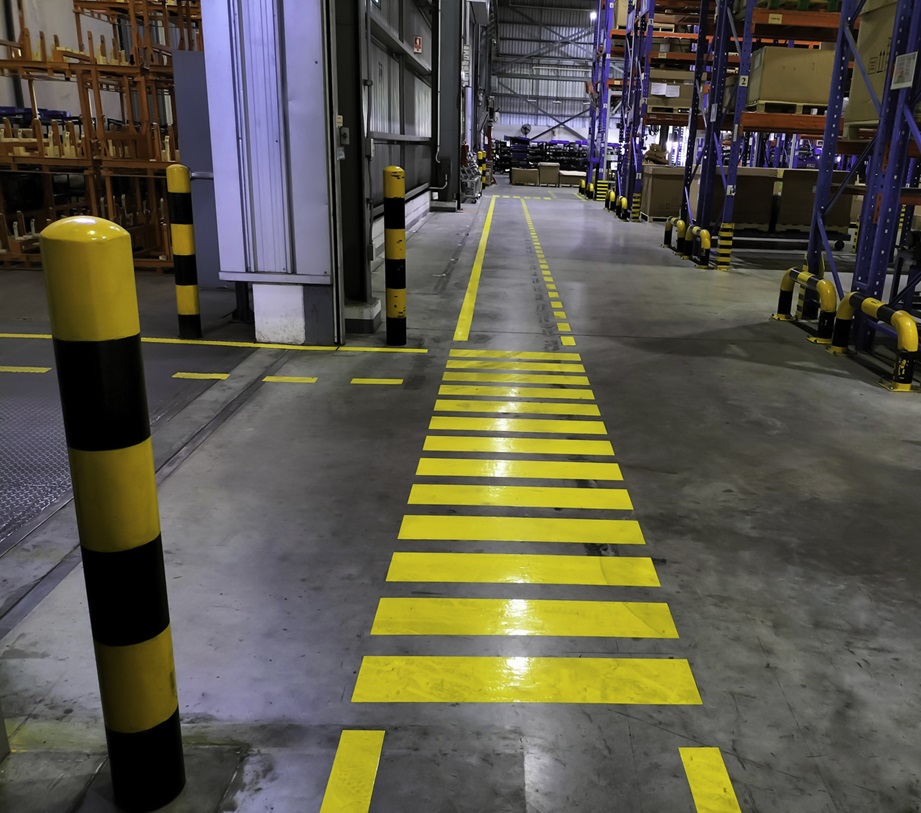
- Clearly marked pedestrian walkways
- Physical barriers and guard rails
- Designated crossing points
- One-way traffic systems
- Speed limits and signage aligned to BS EN ISO 7010 standards.
Warehouse layout design plays a major role here. A poorly configured aisle or blind corner can undermine even the best safety policies. By contrast, intelligent storage planning – such as that delivered by Brysdales’ tailored intralogistics solutions – can reduce vehicle conflict points and optimise flow.
Maintain High Standards of Housekeeping
Housekeeping is one of the simplest – yet most overlooked – compliance measures.
Slips, trips, and falls are among the most common causes of non-fatal workplace injury in the UK. In busy warehouses, cluttered aisles, spillages, and uneven flooring significantly increase the risk.
Best practice housekeeping includes:
- “See it, sort it” culture
- Immediate spill response
- Clear emergency exits
- Routine floor condition checks
- High-level dust removal
- Structured cleaning schedules
Dust accumulation, grease build-up, and debris can also affect machinery efficiency and air quality. Professional industrial cleaning services help maintain hygienic, compliant environments and reduce hazard exposure.
Cleaning should be integrated into safety management systems, not treated as a separate operational task.
Strengthen Manual Handling Controls
Manual handling remains a major contributor to warehouse injury statistics.
To reduce strain and musculoskeletal disorders:
- Use mechanical lifting aids wherever possible
- Provide structured training programmes
- Rotate tasks to prevent repetitive strain
- Review load weights and storage heights
- Ensure racking systems are ergonomically designed
Well-planned storage solutions can reduce unnecessary lifting at awkward heights. Adjustable shelving, mezzanine floors and efficient pick-face layouts – such as those supplied by Brysdales – contribute directly to safer handling practices.
Embed Fire Safety Compliance
Fire safety is a legal obligation under UK legislation. Employers must carry out fire risk assessments and maintain adequate firefighting equipment.
Warehouse-specific fire risks include:
- Flammable stock
- Battery charging stations
- Packaging materials
- Obstructed fire exits
- Poor compartmentalisation
Best practice involves:
- Regular fire drills
- Clearly marked escape routes
- Maintained fire doors
- Routine alarm testing
- Safe storage of hazardous goods
Storage design also impacts fire safety. Appropriate spacing, load limits and compliant mezzanine installations help ensure escape routes and sprinkler coverage remain effective.
Invest in Training and Competency
Even the most advanced safety systems fail without competent staff.
Effective warehouse safety programmes include:
- Forklift operator certification
- Supervisor safety training
- Refresher sessions
- Incident reporting systems
- Toolbox talks
Training reinforces compliance obligations and promotes accountability at every level.
Brysdales’ SEIRS-qualified installation teams and in-house SEMA-approved inspectors demonstrate how specialist knowledge contributes to safer implementation of storage systems. Partnering with accredited experts ensures that installations, inspections, and modifications meet recognised industry standards.
Use Technology and Automation Safely
Modern warehouses increasingly adopt automation, robotics and AI-driven intralogistics. While automation can reduce manual risk exposure, it introduces new safety considerations.
Brysdales supports warehouse automation and tailored intralogistics solutions designed to improve operational efficiency. When implemented correctly, automation can:
- Reduce manual handling
- Minimise vehicle interaction
- Improve picking accuracy
- Enhance space utilisation
However, automation must be supported by:
- Guarding and segregation
- Emergency stop systems
- Clear maintenance procedures
- Risk assessments for new equipment
Compliance must evolve alongside technology.
Build a Safety-First Culture
Compliance is not achieved through paperwork alone; it requires strong leadership, visible accountability, and consistent communication across the organisation. A strong safety culture is built through practices such as encouraging near-miss reporting, maintaining transparent investigation processes, involving senior management, engaging employees in audits, and supporting continuous improvement initiatives. When employees understand that safety is an operational priority rather than simply an administrative requirement, they are more likely to take ownership of workplace standards. Organisations that embed safety into everyday operations typically experience fewer incidents, improved employee engagement, and stronger long-term performance.
Why Partnering with Specialists Matters
Warehouse safety is multi-layered. It involves structural design, operational discipline, inspection regimes, and ongoing monitoring. Attempting to manage all this internally without specialist support can increase risk exposure.
Brysdales positions itself as a trusted partner for comprehensive storage solutions, combining design, installation, inspection, and compliance expertise. As a SEMA Advanced Approved Member with Safe Contractor accreditation, the company demonstrates adherence to rigorous safety and compliance standards.
For warehouse operators seeking to:
- Upgrade racking systems
- Install mezzanine floors
- Improve traffic flow
- Prepare for inspections
- Ensure SEMA-compliant audits
Partnering with an experienced provider can significantly strengthen compliance frameworks.
Building Compliance into Warehouse Safety
Enhancing safety in warehouses is not optional – it is a legal, operational, and ethical necessity. The UK warehousing sector continues to experience significant workplace incidents, reinforcing the importance of structured compliance.
By focusing on robust risk assessments, thorough racking inspection and design, effective vehicle‑pedestrian segregation, consistent housekeeping and cleaning, strong fire and manual handling controls, competent training, and accredited specialist partnerships, organisations can create safer and more productive environments. Compliance should never be reactive; it should be designed into your warehouse from the ground up. With the right systems, leadership, and expert support – such as the tailored storage and compliance services provided by Brysdales – warehouse safety becomes more than a requirement; it becomes a competitive advantage.